"The best way to build trust is to engage with criticism directly rather than avoid it."
Sudden wealth doesn’t curse people, but it does expose them. A minority of lottery winners experience financial collapse or personal strain, often due to pre-existing issues.
This isn't just "money doesn't buy happiness" wisdom. It's a specific psychological outcome that happens when sudden wealth arrives without context, community, or purpose.
When people hear about Dunbarrios, they ask: "Wouldn't this just create 150 lottery winners?" That question haunted the design process. And then something clicked: We might have accidentally designed the antidote.
Summary: A Dunbarrio is a 150-person economic circle with permanent funding. Members keep autonomy; the system coordinates mutual support.
Anthropologist Robin Dunbar discovered that humans can maintain stable relationships with about 150 people. Below 150, you know everyone personally. Above 150, you need bureaucracy because your brain can't track the relationships directly.
Fifty is too small for economic resilience. Five hundred requires hierarchy. One-fifty is the sweet spot: large enough for stability, small enough for genuine accountability.
A wealthy individual (a "Bridge Node") endows the circle with roughly $75 million (for moderate-cost U.S. regions). This creates a trust that generates permanent income without depleting.
Crucially, growth comes through adoption, not just saving. One billionaire funds one circle, tells ten wealthy friends, and they each fund their own.
Yes, selection is exclusive. We chose relational trust over bureaucratic fairness. The Bridge Node starts with their inner five. Those five identify their five. This continues until 150.
Alternative anonymous selection creates the isolation that destroys lottery winners. Means-testing creates bureaucratic gatekeeping. We accept the tension of relational selection because it builds a functional community.
Summary: Dunbarrios address the five specific psychological wounds of sudden wealth: isolation, purpose loss, targeting, guilt, and narrative emptiness.
The lottery winner catastrophe isn't about money; it's about money arriving in a destructive configuration. Dunbarrios heal the five wounds:
We're not creating lottery winners. We're creating participants in collective flourishing.
Structural Proof: The Exit Grant. Every member can leave at any time and receive a departure grant (up to $100,000 vested). The door is unlocked. No cult provides that.
Plus: No guru (rotating authority). No sacred texts (amendable constitution). No belief requirements. External arbitration.
No. You don't sell assets or move to a compound. Your deed stays in your name. Your life stays integrated (keep your job, friends, etc.).
Dunbarrios work within existing legal/economic structures. It's an overlay on normal life, not a replacement for it.
Charity is one-way. Dunbarrios are mutual investment.
Funder gains: 150 people who know your name and would notice if you disappeared. Safety through connection.
Member gains: Security + responsibility to contribute and cascade the model. Mutual flourishing formalized into architecture.
No state ownership. No central planning. No mandatory participation. No elimination of private property. This operates entirely within capitalist legal structures (trusts, cooperatives, insurance) driven by voluntary association.
Dunbarrios is a circle-based coordination system for small groups. It’s inspired by sociocratic “circles” and by self-organization: the group defines its work, signals capacity, and adapts without a manager. But it’s also intentionally constrained, because humans have finite attention. Fixed-size rosters, clear roles, and sprint-bounded execution keep coordination from turning into endless meta-discussion.
We budget for the storm. We assume only 3% real return (not 7%) based on compressed future projections. ~$25-30M for housing, ~$45-50M for corpus.
If returns are higher, we expand faster. If lower, the conservative sizing provides runway.
The portfolio is collapse-aware. 40% is in productive real assets (farmland, renewable energy, workforce housing) that generate utility regardless of market valuations. Even if stocks crash, members have food, energy, and shelter.
Day One: Level-Funded health plans with Specific Stop-Loss insurance. Limits liability to ~$25k/person; insurer pays the rest.
At Scale: Group Captive Insurance Company. A regulated entity owned by circles to pool risk legally. We do NOT use illegal informal pooling (MEWA).
Two entities working together to solve tax issues:
The components (PPTs, Co-ops, Captives) have extensive precedent. The combination is novel. Early circles should budget for legal defense and structure testing. This is pioneer territory.
Summary: We don't eliminate problems; we build compassionate protocols so people aren't abandoned when life gets hard.
Graduated response: Direct Dialog → Mediation → Arbitration → Exclusion. Accountability is relational first, but external arbitration exists for serious disputes (preventing the "tyranny of structurelessness").
We separate economic security from household status. The survivor is relocated immediately with independent stipend. The abuser faces the circle and is removed. The survivor stays. This eliminates the economic trap of abuse.
Treated as medical emergencies, not moral failures. Protocols include care teams, rehab coverage, and extended leave. Security is not conditional on perfection.
Transparency + Graduated Consequences. Nudges → Outreach → "Dimmed" Status → Temporary De-federation. Permanent exile only after 24 months of negative reciprocity and refusal of help. Sovereignty is kept; community access is lost.
No. Ultra-high-net-worth ($50M+) can endow independently. High-net-worth ($10M-$50M) can endow smaller circles. Upper-middle ($1M-$10M) can syndicate funding. Anyone can organize a circle now to be ready.
If you want to maintain control, prefer isolation, can't tolerate accountability, or need guaranteed outcomes—this isn't for you. This is an experiment for those who sense isolation is a losing game.
30-Day Ignition: To get one wealthy individual to commit to trying this with their inner 5.
12-24 Month Proof: The experiment runs with monthly disbursements, documentation, and adjustment.
Every protocol in this model exists because I've seen what happens without it. The rotation of authority exists because I watched power calcify. The exit grants exist because I know what it feels like to be trapped. The external arbitration exists because I've been through a lawsuit that could have been avoided.
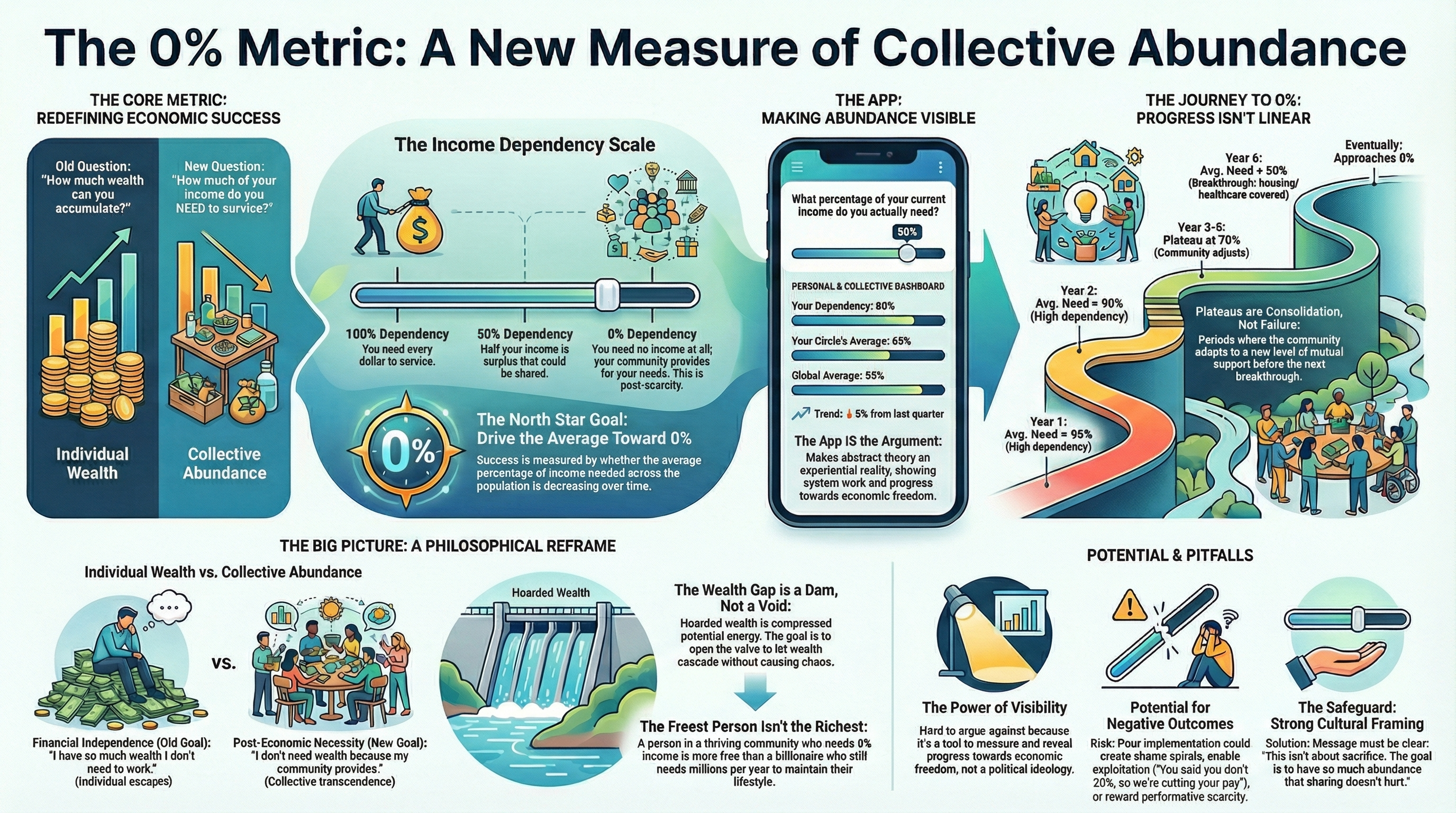
The Dunbarrios app (in development) is not claiming to have all the answers, yet this pattern is worth stress-testing. The goal isn't to defend a fixed system—it's to build something that actually works.
The best questions come from skeptics who engage seriously with the ideas. That's what this FAQ is for—and if your question isn't here, it means we need to add it: contact@dunbarrios.com