01
One person remembers everything.
Recurring work, context, and follow-up quietly collect in one person's head.
DUNBARRIOS · PRIVATE BETA
For households, care circles, small businesses and local teams that repeatedly share responsibility: make recurring work, decisions and know-how easier to carry together.
Start personally. Bring the group in when there is something worth sharing.
Small circles· Private by default· No public feed
THE PROBLEM
The difficult part is making that reliance visible, fair enough to live with, and capable of improving over time.
01
Recurring work, context, and follow-up quietly collect in one person's head.
02
Responsibility exists, but the agreement around it does not.
03
A workaround succeeds once and then disappears into memory.
04
Documentation may remain while the actual ability to do the work disappears.
05
Then the hidden power structure suddenly becomes visible.
06
Money, expertise, or reliability can create authority nobody explicitly agreed to grant.
Dunbarrios starts from the dependency that is already there and asks whether we can handle it more deliberately.
WHERE IT FITS
Life together
Recurring chores, appointments, maintenance, transport, meals, planning and all the things somebody otherwise has to remember.
Work together
Recurring operations, handoffs, onboarding, shared procedures, customer work, and knowledge that should not disappear when one person is unavailable.
Support together
Ongoing care, check-ins, practical support and shared responsibility where helping should not quietly turn into authority over the person being helped.
Dunbarrios is designed for human-scale groups and can also be used with multiple teams working on the same goal.
THE SHAPE
Small enough to be understandable.
Connected enough to be durable.
Dunbarrios is a framework for small groups that repeatedly depend on one another: to coordinate work, make decisions, preserve useful know-how and improve how they do things together.
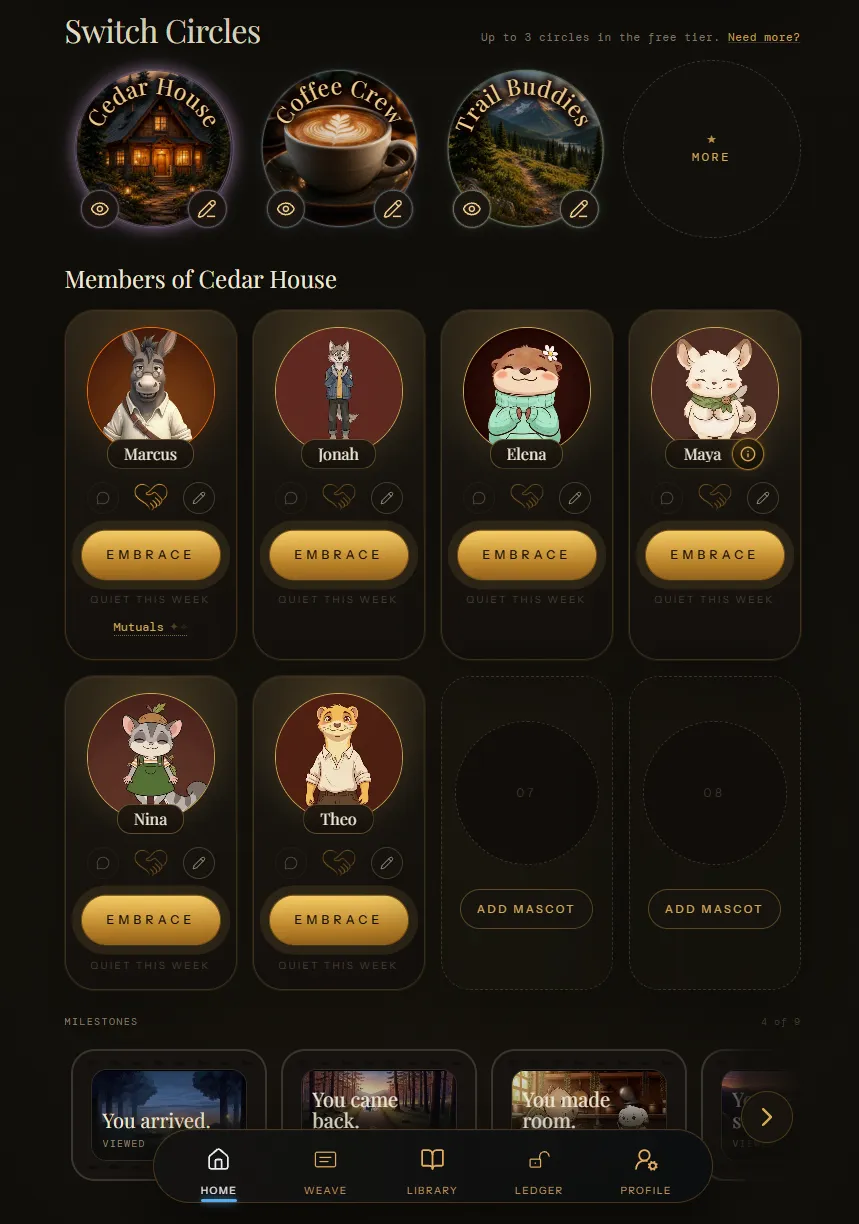
DunbarrioSolo is the personal doorway into that framework. You begin privately, notice the people and responsibilities around you, and involve others only when there is something worth sharing.
Dunbar refers to Robin Dunbar’s work on the human scale of recurring relationships.Barrio means neighborhood: a social world built from people who encounter one another again.
WHY IT STARTS PERSONALLY
Most coordination software begins by creating a shared workspace and asking everybody else to join.
DunbarrioSolo begins one step earlier. Private reflection, small circles and low-stakes practice let you notice relationships and recurring responsibilities before asking a whole group to formalize them.
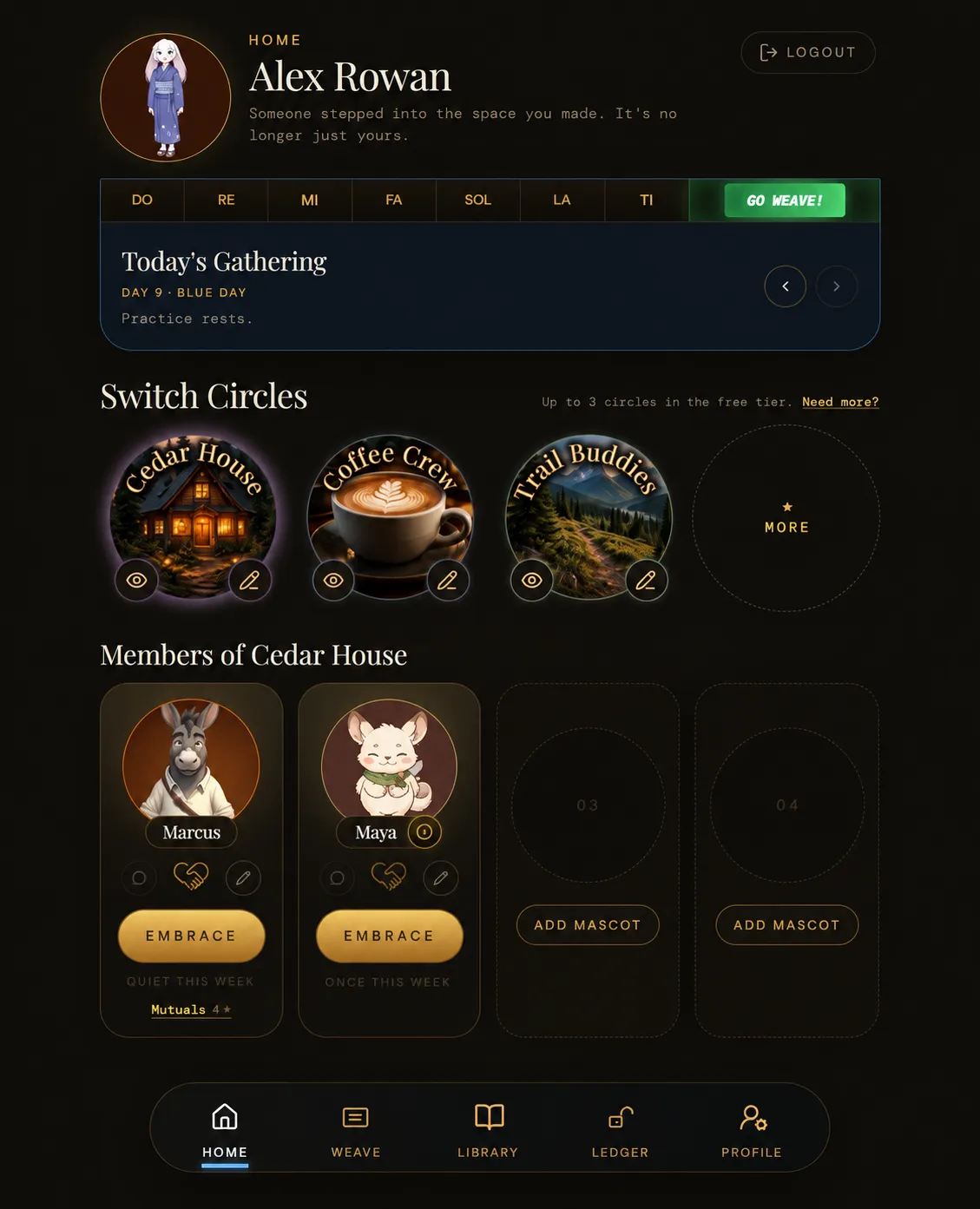
The warmer, more playful beginning is intentional. Mascots can hold places in a circle while you are still exploring it, and the experience gives people room to understand the practice before everyone is ready to participate.
FROM PERSONAL CIRCLE TO SHARED DUNBARRIO
Notice the people, responsibilities and patterns already present.
Invite participants when they are ready to take part themselves.
Review who and what comes with the circle, resolve readiness, and decide whether the group is prepared to become shared.
When the circle is ready, its members can choose to become a shared Dunbarrio.
Graduation is the transition from a personal circle into a shared Dunbarrio. It is a deliberate group decision, not an automatic unlock.
THE PRACTICE
Once responsibility becomes shared, Dunbarrios helps the group keep the work visible and useful experience from disappearing back into individual memory.
When a change affects the group's shared structure rather than one task, it becomes an explicit proposal rather than a silent administrative decision.
Make recurring work, expectations and roles visible instead of leaving them implicit.
Each person sees what actually needs their attention without having to inspect the whole machine.
Keep completion, notes, decisions and useful context attached to the group instead of one person's memory.
Revise routines and procedures deliberately when practice shows they can work better.
The goal is simple: the tenth time a group does something should benefit from the first nine.
INSIDE DUNBARRIOS
HOME
HOME keeps your own responsibilities, circle context and current role visible without turning the entire group into a dashboard.
HOME · CURRENT RESPONSIBILITIES
Approved HOME capture showing a member's responsibilities, circle context, and current role is still needed.
CIRCLE DETAIL
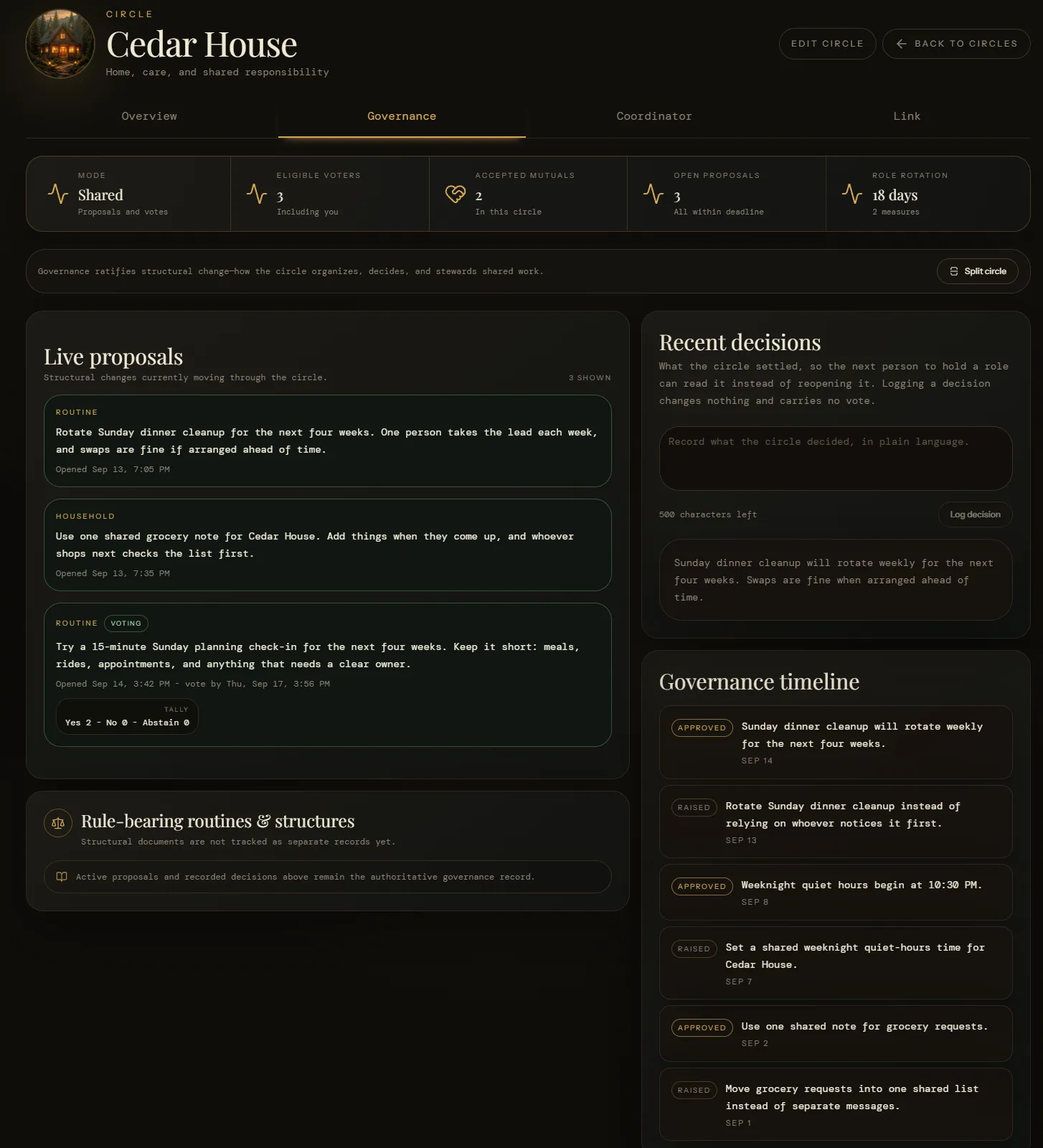
Circle Detail makes shared work, governance, rotating responsibilities and the state of the group legible to everyone involved.
LEDGER
The Ledger keeps a durable trace of relevant activity and decisions so the group does not have to reconstruct its own history from memory.
LEDGER · SHARED HISTORY
Approved Ledger capture showing relevant group activity and decisions is still needed.
DESIGN CONSTRAINTS
Dunbarrios begins with a claim about responsibility, but that claim also limits what the software should be allowed to do.
The system can surface situations without reducing a person to a number.
Metrics can inform human judgment. They should not quietly become sanctions.
Financial support distributed within a Dunbarrio must not buy ideological conformity or permanent governance authority.
Coordination roles rotate. Structural change remains visible to the group.
The point is to make support more dependable without making people more governable.
NOT ANOTHER FEED
Dunbarrios is not built around followers, public posting, audience growth, or engagement maximization. Circles are bounded, sharing is contextual, and privacy is the default.
Keep your people close. Circles are intentionally small and clear.
Share in the right circle, at the right time, for the right context.
Your data, your circles, your boundaries. Privacy is built in, not an afterthought.
No feed to perform for. No follower count to maintain.No reason for every relationship to pass through the platform.
THE DEEPER IDEA
Dunbarrios calls this collective procedural learning.
Repeated work produces experience. Useful experience can improve the procedure. A better procedure can survive role rotation, absence and the limits of individual memory.
The point is not merely to document what happened. It is to let the group's accumulated practice become useful the next time.
A blueprint is not the same thing as capability. What matters is whether the group can actually keep doing the thing reliably.
BEYOND ONE CIRCLE
The larger direction for Dunbarrios is to let bounded groups coordinate with other bounded groups without flattening everybody into one enormous network.
THE ROTATING ‘LINK’ ROLE
A rotating outward-facing role that lets one circle maintain relationships with others without requiring every member to participate everywhere.
WORKSHOP
A place for useful routines, procedures and lessons to become reusable rather than disappearing inside one circle.
FEDERATION
Groups cooperating across boundaries in adjacent areas can discover each other while remaining small enough for responsibility and voice to stay legible.
STEWARDSHIP
Stewardship explores whether people with greater financial capacity can help sustain a human-scale community while standing inside it as members rather than above it as benefactors.
The people receiving support remain free to disagree and participate in governance.
Contribution should increase carrying capacity, not purchase control.
THE EXPERIMENT
We see Dunbarrios as an attempt to renew the social contract through commitments people can actually practice together.
Adoption is the referendum.
The test is not whether the theory sounds elegant. The test is whether people become more secure, more capable and more able to act for themselves.

PRIVATE BETA
We're inviting a limited number of households, care circles, small teams and other real groups willing to use Dunbarrios consistently and tell us where it succeeds, fails, confuses or gets in the way.
We’re keeping cohorts intentionally small.
This beta is a good fit if the following are true for you:
A household, care circle, small team, or similar.
Not just you — actual team or household members.
We’re looking for consistent, real-world use.
Tell us what’s working, what’s not, and what’s missing.
Private-beta invitations will roll out gradually while the remaining beta pieces are completed.
Applications are reviewed individually. Applying does not guarantee immediate access.
QUESTIONS
Here are some common questions. Each one links to a deeper answer in our FAQ.
Read the FAQ


